Legacy applications and integration inventory

Total Quality Logistics (TQL)
Research
I interviewed sales leaders and their assistants and shadowed daily work to understand how they moved between applications. I documented screen placement, use cases, and recurring problems rather than evaluating the navigation in isolation.
That operational context informed the shell architecture, application access, and menu behavior.
Exploration
I gathered sales-floor feedback on the horizontal-menu iteration before moving to a vertical drop menu. The comparison made screen-space trade-offs visible.

Design decisions
Feedback on the horizontal ribbon led me toward a vertical drop menu. Screen space was valuable across the applications, so I changed the navigation direction while preserving familiar favorites.
The trade-off was to concentrate application choices in an expandable menu while leaving more of the working view available.

Design decisions
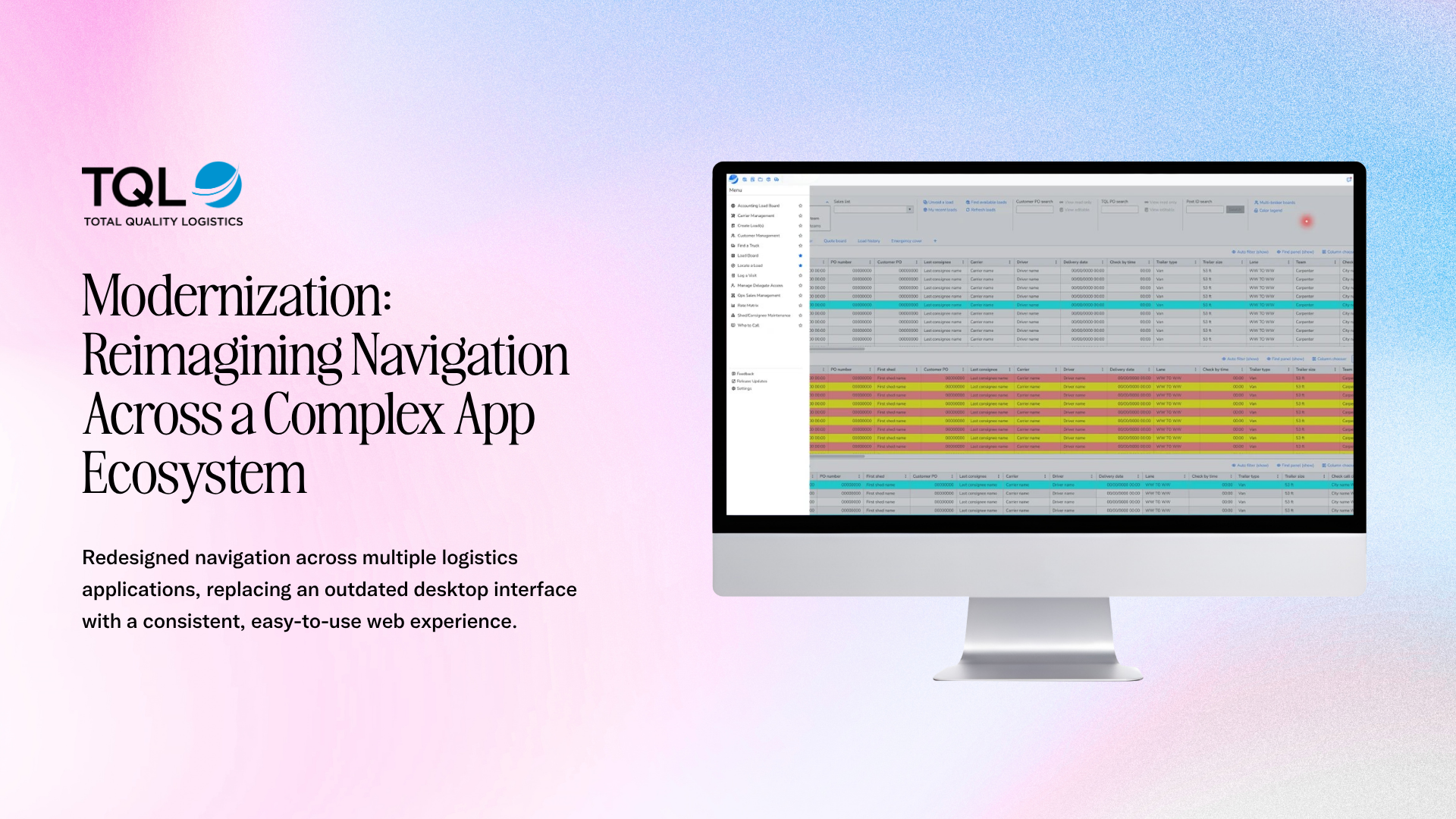
The shell’s responsibility was navigation and application access, rather than rebuilding the applications themselves. I tracked how each application opened so the team could identify the connections needed for the web-based shell.
I partnered with engineering on interaction behavior and presented the approved direction to developers to work through technical scope and architecture.
Delivery
The vertical-menu direction was approved and presented to developers for technical scope and architecture. The handoff included navigation behavior, application access, and reusable patterns.
Delivery
I presented and defended design decisions in whiteboard sessions with developers, working through interaction details and technical constraints.
I worked alongside development and reviewed implementation for visual and functional fidelity. That partnership was part of delivery, not just a final Figma handoff.
Complete boards and additional screens behind the selected details above. Enlarge any artifact to inspect it at full size.
